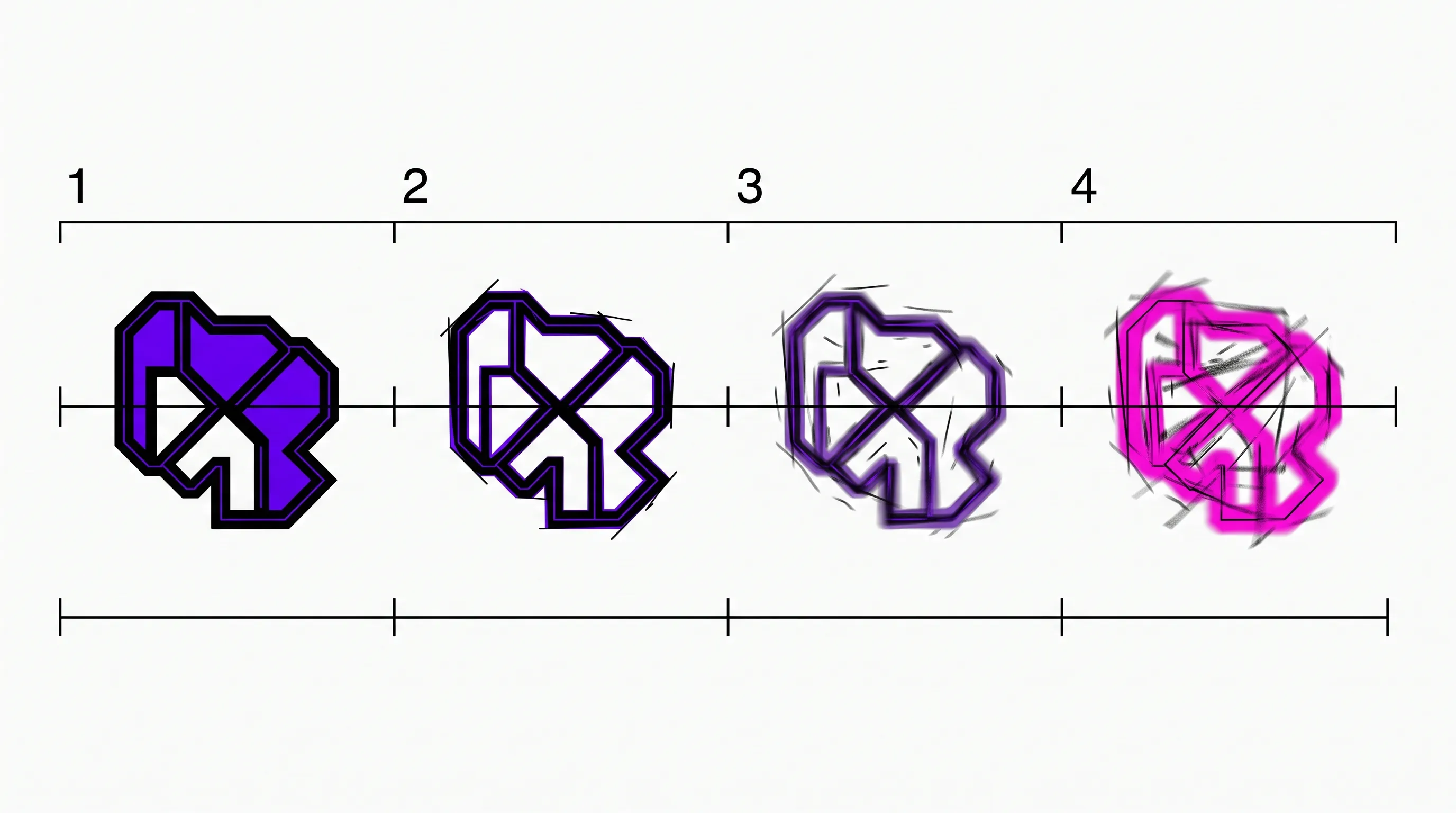
The story changes a little at each handoff between writer, designer, illustrator and developer, and every change is locally reasonable. Record constraints and keep one person accountable for the argument at every stage.
The pattern
The team agrees the narrative. Everyone signs off. Then one person writes it, another designs it, a third illustrates it and a fourth builds it.
At the end, the finished site has drifted from what was agreed, and nobody can point to the moment it changed.
Why it breaks
Each handoff changed it a little, for a reason that made sense at that desk.
The writer needed a shorter heading, so a conditional claim became an absolute one. The designer needed a balanced three-column row, so a two-step sequence gained a third step that is padding. The illustrator needed the figure to read at slide size, so a mechanism with a causal direction became a symmetrical diagram. The developer needed the section to work on a phone, so a sequence that revealed in order became four blocks that arrive at once.
Each of those people made a sound decision in their own craft, and each decision had consequences one discipline downstream. No one in that chain was accountable for the argument end to end.
What changes
Two things.
First, the structure has to record decisions as well as conclusions. “The platform section leads” is a conclusion. “The platform section leads, the three steps are causal and must be read in order, and step two cannot be shown before step one” is a decision that survives translation. Constraints travel. Summaries do not.
Second, someone has to be accountable for the argument at every stage, with enough craft to see the consequence coming. Good communication between specialists meets a different requirement. A person who can see that a symmetrical layout will destroy a causal claim has to be looking at the layout.
The practical result
The finished work says what was agreed, and review comments point at a specific constraint. Stakeholders who would have said “this feels off” can say “step two is appearing before step one”, because someone wrote the constraint down and anyone can check it.
Where the constraint cannot survive a format, someone records the loss as a decision. Sometimes the right answer is that the format changes.
Few costs in investor communication get less examination than the distance between what a company decided to say and what its finished materials say. Four small errors that nobody owned almost always cause it.